


On the eve of a City Council hearing, Speaker Julie Menin announced significant revisions to two closely watched protest bills, removing a mandatory 100-foot security perimeter requirement and replacing it with a more flexible framework developed in consultation with the NYPD.
The original measures — Int. 1 and Int. 175, sponsored by Menin and Bronx Council Member Eric Dinowitz, would have required the police commissioner to establish fixed security perimeters at every entrance and exit of houses of worship and educational facilities in instances of intimidation or harassment. Those perimeters could extend up to 100 feet and would have required barriers such as police tape or barricades.
The amended versions, Int. 1-A and 175-A, remove the 100-foot specification, eliminate the barrier mandate, and no longer require fixed perimeters at every entrance and exit. Instead, they direct the police commissioner to produce a proposed plan within 45 days and a final plan within 90 days outlining considerations for when and how buffer zones may be used. Implementation would follow within 120 days.
The revised bills also state that the NYPD’s plan must preserve protest rights and clarify that nothing in the law may infringe on labor rights. The legislation does not create new criminal penalties.
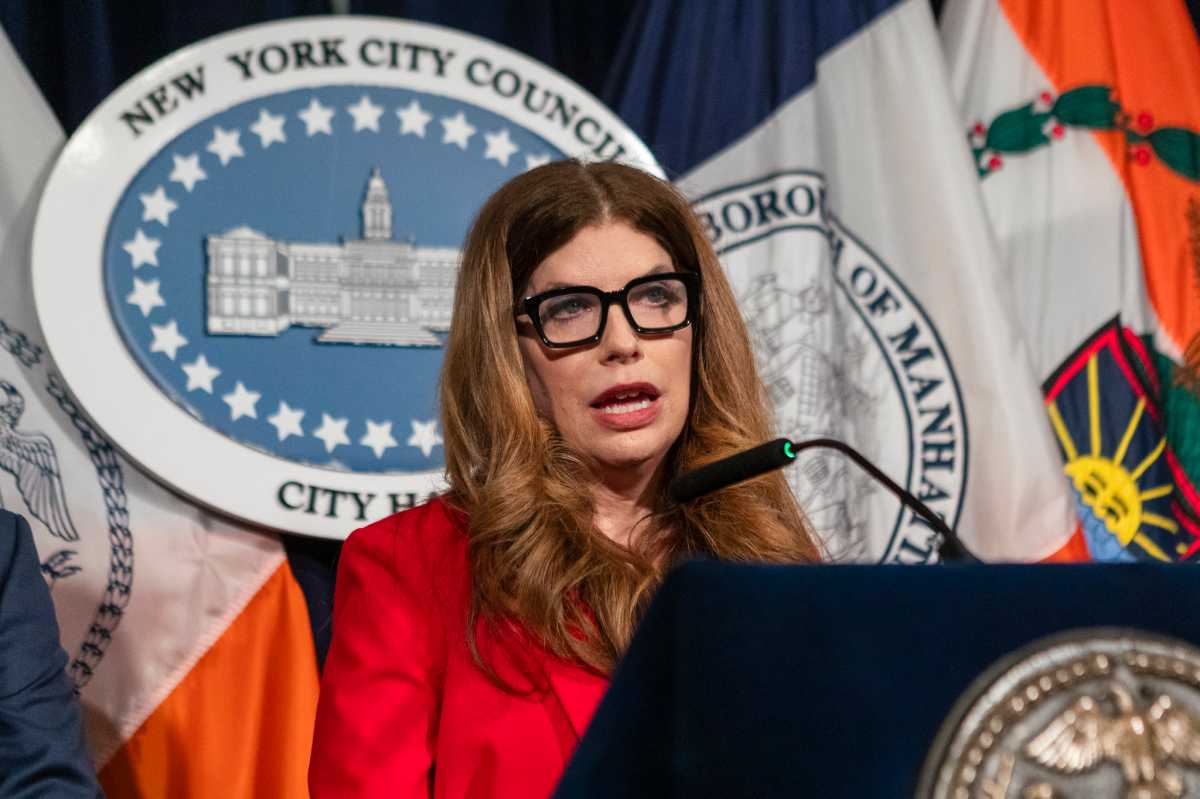
Speaking at a press conference on Tuesday, Menin said the changes followed discussions with Police Commissioner Jessica Tisch after she raised concerns about the original bills’ content.
“In the past few days, we’ve had incredibly productive conversations with Commissioner Tish,” Menin said. “We’ve updated the legislation to account for the NYPD feedback, and we very much appreciate their thoughtful input.”
“In short, the bills establish clear considerations for buffer zones around entrances and exits for houses of worship and schools, and the bills both create those buffer zones but also protect the right to peacefully protest and honor protesters’ First Amendment rights,” she said.
Menin emphasized that the removal of the 100-foot requirement was intentional.
“One of the changes in the bill … removes a specific 100-foot stipulation to give the NYPD flexibility on the exact size of the perimeter, whether it be both smaller or larger, and to ensure that there is a safe environment for anyone trying to enter schools and houses of worship,” she said.
She repeatedly described the legislation as content-neutral.
“There’s nothing in here that talks about banning anything,” Menin said. “The bills don’t infringe on protest rights, labor rights, or create any new criminal penalties; they actually don’t discuss penalties at all.”
Menin introduced the legislation last month through the Council’s Committee to Combat Hate as part of a broader five-point plan to address antisemitism. The package includes creating a reporting hotline, funding security at private schools, and providing community-based security training.
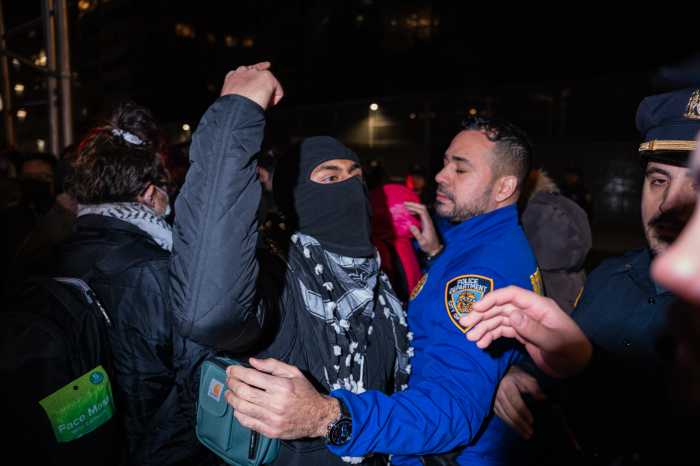
The perimeter proposal followed demonstrations against outside synagogues in Manhattan and Queens, with protestors gathered to oppose sale events of occupied land in the West Bank.
“What happened at Park East Synagogue and Kew Gardens should never happen again,” Menin said of the incidents, which drew widespread condemnation after rival protestors clashed outside the Park East synagogue, and some protestors chanted in support of Hamas outside the Kew Gardens location.
Civil liberties advocates and a coalition of pro-Palestinian, reproductive justice, and labor groups previously criticized the original versions of the bills, arguing they would create overly broad protest-free zones across large parts of the city. Menin rejected the suggestion that the legislation targets particular viewpoints.
“This is content neutral in terms of any kind of protest,” she said. “We don’t say anything about the type of protests. It’s absolutely content-neutral.”
She added that the focus is on safe access to religious institutions and schools. “This is really about safe access to a house of worship,” Menin said. “It’s a very straightforward bill that protects safe access to houses of worship and to schools.”
NYC for Abortion Rights and PAL-Awda, who are among the groups testifying in opposition on Wednesday, stated that they will continue to oppose the bills, regardless of any further amendments.
“We reject the premise of these bills, which seek to unconstitutionally target and stifle Pro-Palestine speech. Further, we find it dangerous for any plan to rely on the judgement and discretion of the NYPD, which has a documented and widespread history of violence and bias when it comes to handling protests,” the organizations said in a statement.
Menin said the NYPD supports the revised legislation after the amendments were incorporated, describing the discussions with the department as “very productive.”
A law enforcement source confirmed to amNewYork that NYPD Deputy Commissioner of Legal Matters Michael Gerber is set to testify in favor of the amended bills at Wednesday’s hearing.