

Wednesday, Feb. 11, marks the 42nd day of Zohran Mamdani’s term as mayor. amNewYork is following Mamdani around his first 100 days in office as we closely track his progress on fulfilling campaign promises, appointing key leaders to government posts, and managing the city’s finances. Here’s a summary of what the mayor did.
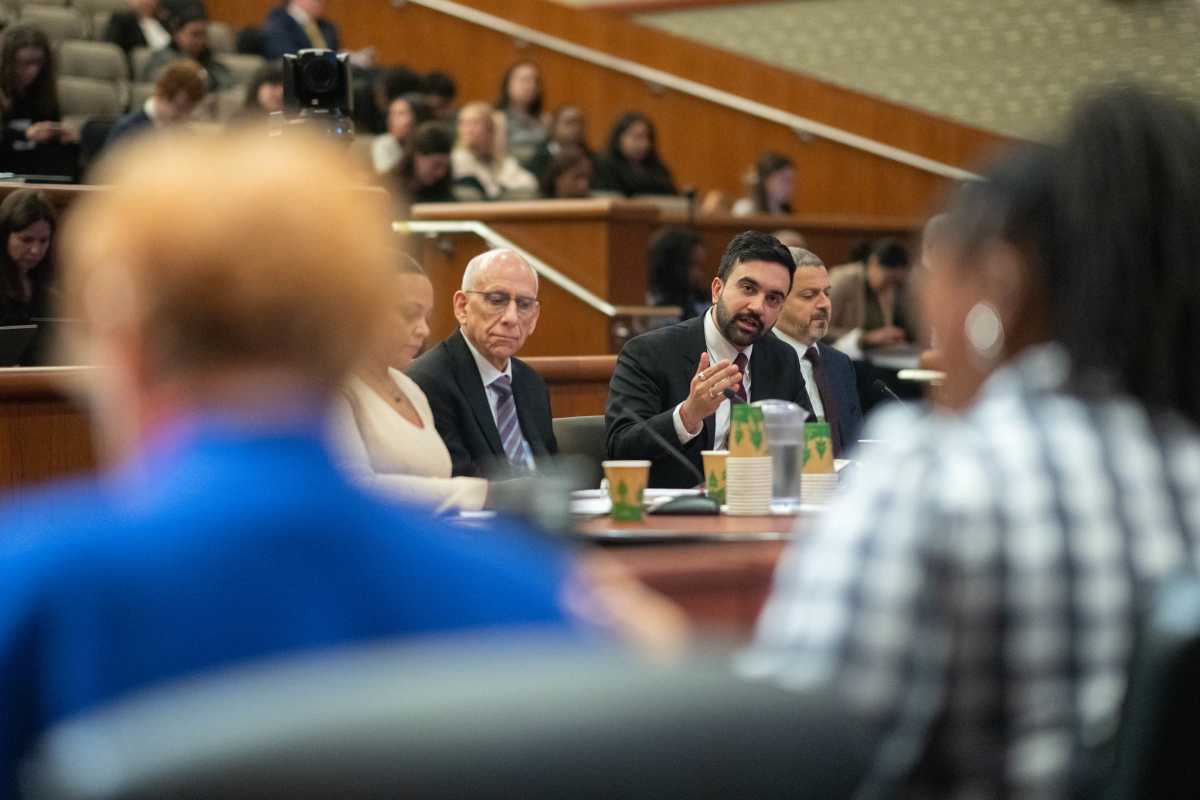
On “Tin Cup Day,” Mayor Zohran Mamdani told Albany lawmakers that his administration had lowered the city’s previously projected two-year budget deficit by $5 billion — but warned that without new recurring revenue, New York City remains “on a ledge.”
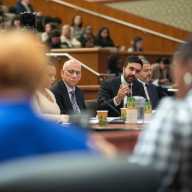
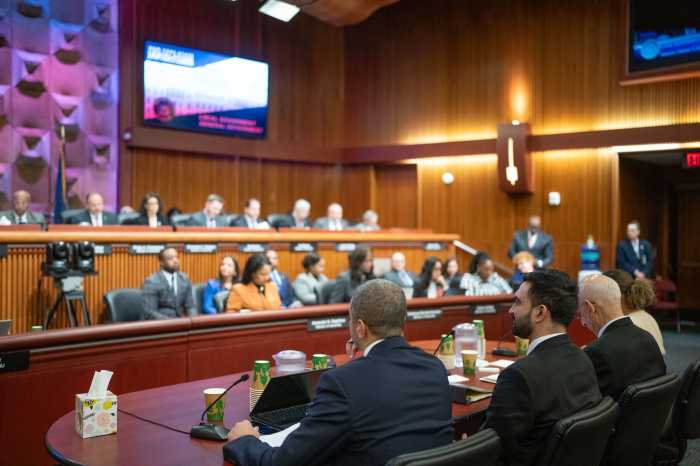
Testifying Feb. 11 before state lawmakers at the annual Joint Legislative Budget Hearing, Mamdani said that by “assuming an aggressive posture on savings without compromising city services, incorporating updated revenue and bonus estimates, and using in-year reserves,” the administration reduced what had been a $12 billion projected gap to $7 billion. He did not quantify how much would be taken out of the reserves.
Still, he made clear that savings alone will not close the hole — and renewed his push for higher taxes on the city’s wealthiest residents — even as several lawmakers questioned the wisdom of that approach and Gov. Kathy Hochul’s repeated pushback on the plan.
“We’ve made some meaningful progress towards shrinking the gap. However, New York City is still placed on a ledge. The most responsible way off is with dedicated, recurring revenue that can provide the services New Yorkers deserve,” the mayor said, adding that the imbalance in the city’s relationship with the state is draining the city’s resources.
“We are calling to end the drain,” he added. “This is not just a crucial first step, it is a key part of the problem. Without solving this inequity, we will only postpone this crisis.”
But he also squarely blamed what he dubbed the “ABC — the Adams Budget Crisis” for much of the city’s fiscal strain, repeating his accusation that the former Mayor Eric Adams was responsible for “gross fiscal mismanagement.”
“Budget gaps are twice as large as what he said they would be, to the tune of billions of dollars,” Mamdani said, pointing to programs he said were severely underbudgeted: $860 million allocated for cash assistance when the need was $1.6 billion; $1.1 billion for rental assistance when the need was $1.8 billion; and $1.5 billion for shelters when the need was $2 billion.
Former Mayor Adams pushed back on Mamdani’s characterization of the so-called “Adams Budget Crisis,” writing on X that the newly announced $5 billion reduction in the projected deficit undercuts the mayor’s earlier warnings.
“Four weeks later and Mayor Mamdani suddenly ‘finds’ $5 billion,” Adams wrote. “Give him another month, maybe the other $7 billion appears, too.”
Adams added that the original $12 billion deficit “was never real,” calling it a “scare tactic to pressure the state into raising taxes,” and arguing that “nothing is free, someone always pays.”
Compounding those pressures, he argued, is a structural imbalance in the fiscal relationship between the city and the state.
“New York City contributes 54.5% of state revenue but only receives 40.5% back,” Mamdani said, adding that in fiscal year 2022 the city contributed “$21 billion more than we received back.”
Speaking to reporters on Tuesday, Gov. Kathy Hochul signaled little appetite for shifting a larger share of the state budget to the city, arguing that Albany has already significantly increased its support.
“Let me say this, I already have — since I am governor, we’ve increased our support for New York City by 33% from my predecessor,” she said, adding that the city now receives roughly $25 billion in state funding for housing, childcare, and education.
“I have stepped up without anybody having been in my ear, because I know it was the right thing to do to support New York City,” Hochul added, noting that she remains committed to the city’s success and has had “robust conversations” with Mamdani since his election about how to manage fiscal pressures.
A source familiar with the governor’s budget pointed to what the administration describes as a significant increase in state support for NYC since Hochul took office, noting that state funding to the city has grown by more than 33% — or $6.4 billion — to $25.6 billion in the proposed 2026 state fiscal year budget, with an additional $1.9 billion proposed this year.
AIM funding and state support
Regarding the imbalance, Mamdani specifically pointed to the elimination of Aid and Incentives for Municipalities (AIM) funding for New York City in 2010, saying it has deprived the city of at least $4.8 billion over 16 years.
“New York City is the only eligible municipality in our state that receives nothing,” he said.
Assembly Member Patrick Burke, chair of the Cities Committee, pressed the administration on the impact of losing AIM funding and whether New York City’s request for additional state resources was fair given fiscal pressures in other municipalities.
First Deputy Mayor Dean Fuleihan responded on behalf of the administration, reinforcing that restoring AIM funding to New York City would provide meaningful recurring support and help stabilize the city’s finances. The administration maintained that the city’s outsized contribution to state revenues justifies revisiting the distribution formula.
Mamdani returned repeatedly to the theme of imbalance throughout Wednesday morning’s proceedings.
“No one gives more and gets less in return than New York City,” he said, arguing that without addressing that inequity, “we will only postpone this crisis.”
‘We can’t cut our way out’
Questions quickly turned to how the administration plans to close the remaining $7 billion gap. Former City Council member and now-state Sen. Erik Bottcher asked about whether the city could close the deficit through spending reductions.
Sherif Soliman, director of the Office of Management and Budget, said the administration would continue identifying efficiencies but cautioned that reductions alone will not solve the problem.
Cuts will be done “with a scalpel,” Soliman said, but “we can’t cut our way out of the budget crisis.”
He told lawmakers the administration discovered more than $8 billion in expenses that had not been properly budgeted under the prior administration, contributing significantly to the inherited deficit.
Bottcher also queried Mamdani’s administration on how its newly created “Chief Savings Officers” would differ from prior city budget-cutting exercises known as Programs to Eliminate the Gap, or PEGs. Executive Order 12 designates a senior employee at each city agency as a “Chief Savings Officer” tasked with identifying savings within 45 days. would avoid becoming another version of across-the-board cuts.
In response, Soliman said the administration is seeking targeted reductions rather than blunt, agencywide trims. The chief savings officers will examine external and consulting contracts, review programs that use data and performance metrics, and assess operational efficiencies, he said.
Soliman said the administration expects the effort to generate more than $1 billion in savings that could be incorporated into the city’s financial plan to help close the remaining budget gap. He said the estimate is informed in part by past agency submissions under previous gap-closing programs and by a review of major cost centers.
Pressed for a concrete example of inefficiency and evidence that $1 billion in savings could realistically be found, the administration pointed to staffing shortages at the Department of Finance.
The budget director said the agency is short on auditors, noting that at one point the Internal Revenue Service had drawn auditors away. He suggested the city now believes it may be able to recruit some of them back. The vacancies, he said, illustrate how unfilled critical roles can hamper revenue collection.
Bottcher questioned how thousands of vacant positions — many left over from the Adams administration — would affect the mayor’s savings plan, asking whether the city would first need to fill key roles before identifying efficiencies.
Mayor Mamdani responded that some vacancies may have ultimately cost the city more money than they saved. He cited repeated findings by the city’s Independent Budget Office that hiring more auditors could increase tax revenue collections. In past years, he said, the justification of savings had been used to avoid filling those roles.
Mamdani said the administration intends to evaluate the impact of such staffing decisions as it works to close thousands of vacancies across city government, arguing that restoring capacity in critical functions is necessary to improve service delivery and rebuild public trust. He said further details would be included in the preliminary budget set for release Feb. 17.
Assembly Member Michaelle Solages questioned the administration about projected budget gaps in the next two fiscal years. Mamdani acknowledged his team expected fiscal strain, but “not to the scale that we did.” Soliman further explained how previously unbudgeted obligations compounded the gap and said more details would be provided in the preliminary budget.
The mayor told lawmakers additional specifics would be unveiled on Feb. 17, pledging transparency.
The wealth tax fight
At the center of the hearing was Mamdani’s proposal to raise taxes on the city’s highest earners.
“I believe that the wealthiest individuals and most profitable contribute a little bit more so that everyone can live lives of dignity,” he said. “That’s why, along with raising the corporate tax, I’m asking for a 2% raise in personal income taxes on the most affluent New Yorkers.”
He framed the increase as targeted: someone earning $1 million annually “can afford to contribute $20,000 more in taxes,” he said.
“That 2% tax alone would resolve nearly half of our budget deficit.”
Suffolk County Sen. Monica Martinez challenged that assertion, asking how the city would prevent businesses and wealthy residents from relocating to other states.
“How do you plan on balancing the increase that you are proposing to ensure that, one, we don’t lose businesses to other states?” she asked.
Mamdani responded that a 2% increase would not trigger an exodus.
“Two percent is not enough to make the wealthy flee the city,” he said, arguing that New York’s economic ecosystem and opportunities remain strong incentives to stay.
Martinez pushed back, calling his claim “disingenuous” and referencing prior tax increases in 2021.
Other Republican lawmakers raised similar concerns. Assembly Member Philip Palmesano pressed the mayor on whether his tax policy could drive people and businesses out of New York. Mamdani maintained that recurring revenue is necessary to preserve services and stabilize the city’s finances.
Mamdani’s path forward on a local tax increase for high earners could hinge on passage of the Fair Share Act, legislation sponsored by State Sen. John Liu and Assembly Member Phara Souffrant Forrest that would authorize New York City to levy a 2% surcharge on income above $1 million.
The surcharge would apply only to earnings over that threshold, not total income, and supporters argue it would create a more progressive tax structure while generating billions annually for long-term investments in housing, childcare, transit and other affordability measures. The mayor repeatedly backed the legislation during Wednesday’s hearing.
This is a developing story. Check back for updates.