

Vision Zero in Queens: A Decade of Progress, But Pedestrians Still Face Serious Risks
When New York City launched Vision Zero in 2014, it represented one of the most ambitious traffic safety initiatives in the city’s history. The goal was bold and uncompromising: eliminate all traffic deaths on city streets. Now, more than a decade later, the program has achieved meaningful successes, however, the data tells us that pedestrians in Queens still face significant dangers every single day.
The Promise of Vision Zero
Vision Zero arrived in New York City with the understanding that traffic deaths are not inevitable accidents but preventable tragedies. The program borrowed its framework from Sweden, where a similar initiative had dramatically reduced road fatalities since the 1990s. The core philosophy is straightforward: human life should take priority over convenience, and city streets should be designed to protect the most vulnerable users—pedestrians and cyclists.
In Queens, this philosophy translated into tangible infrastructure changes. Perhaps no project better exemplifies Vision Zero’s potential than the transformation of Queens Boulevard. Once nicknamed the “Boulevard of Death” due to its staggering pedestrian fatality rate, Queens Boulevard underwent a comprehensive redesign that has become a model for safety-focused street planning.
The redesign introduced expanded medians that give pedestrians a safe refuge when crossing the boulevard’s many lanes. New bike lanes separated cyclists from vehicle traffic, reducing conflicts between different road users. Pedestrian islands were installed at key intersections, breaking up long crossings into more manageable segments. Signal timing was adjusted to give pedestrians more time to cross safely.
The results on Queens Boulevard have been encouraging. From 1993 to 2000, 72 pedestrians were killed trying to cross Queens Boulevard, or an average of 10 per year, and since the implementations of Vision Zero fatalities dropped significantly, proving that thoughtful infrastructure investment can save lives. For residents who remember the fear of crossing Queens Boulevard in previous decades, the transformation represents real progress.
The Troubling Reality Behind the Numbers
Yet when we examine the broader picture, it becomes clear that Vision Zero’s work is far from finished. The data from Queens tells a sobering story about pedestrian safety in our borough.
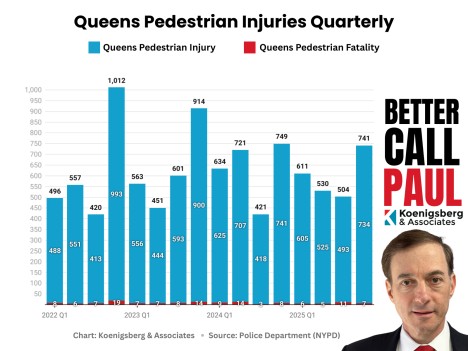
Looking at quarterly pedestrian injury and fatality data from the NYPD, we see that Queens continues to experience hundreds of pedestrian injuries every single quarter. The numbers fluctuate seasonally, with some quarters recording over 700 injuries and others dipping closer to 400, but the overall volume remains persistently high.
The fourth quarter of 2022 saw 993 pedestrian injuries in Queens alone, the peak in recent years. While more recent quarters have shown somewhat lower numbers, these statistics represent real people whose lives have been disrupted by traffic violence.Fatalities, while smaller in number, remain a constant presence. The data shows that Queens loses pedestrians to traffic violence every quarter. Behind each of these numbers is a family forever changed, a community member lost.
The citywide picture reinforces these concerns. According to NYPD motor vehicle crash data, traffic violence has seriously injured 180 New Yorkers so far in 2026, and have resulted in the death of one of our neighbors already. This trend in serious injuries suggests that despite Vision Zero’s efforts, the city still has work to do on key safety metrics.
A Unified Approach to Vulnerable Road Users
One of Vision Zero’s strengths is its recognition that pedestrian and cyclist safety are interconnected challenges requiring unified solutions. When streets are redesigned to calm traffic and create protected spaces for cyclists, pedestrians benefit too. When signal timing is adjusted to give people more time to cross, everyone outside a vehicle gains an additional margin of safety.
This integrated approach matters because the same factors that endanger pedestrians—speeding vehicles, distracted drivers, poorly designed intersections—also threaten cyclists. By addressing these root causes rather than treating each mode of transportation separately, Vision Zero creates compounding benefits for all vulnerable road users.
However, this unified approach also means that failures affect everyone. When enforcement lapses, when infrastructure projects are delayed, when political will wavers, both pedestrians and cyclists pay the price.
What Every Queens Pedestrian Should Know
Given the ongoing risks that pedestrians face, it’s essential to understand both your rights and your vulnerabilities when walking on Queens streets.
New York City law provides strong protections for pedestrians, particularly those using crosswalks. Drivers are required to yield to pedestrians who have entered a crosswalk, and failure to do so can result in significant legal liability. These protections exist because the law recognizes the fundamental imbalance between a person on foot and a multi-ton vehicle—pedestrians simply cannot protect themselves the way drivers are protected by their vehicles.
If you are involved in a pedestrian accident, documentation becomes critically important. Photographs of the scene, witness contact information, police report numbers, and medical records all play vital roles in any subsequent legal proceedings. The moments after an accident are often chaotic and frightening, but taking steps to preserve evidence can make a significant difference in protecting your rights later.
It’s also important to recognize that following all the rules does not guarantee safety. Pedestrians who cross at marked crosswalks, wait for walk signals, and remain attentive to their surroundings are still injured every day in Queens. The data makes this painfully clear: hundreds of our neighbors are hurt each quarter despite their best efforts to stay safe. This vulnerability is not a personal failing—it reflects the inherent risks of sharing streets with vehicles.
When to Call a Pedestrian Accident Lawyer
If you’ve been injured in a pedestrian accident, navigating the aftermath alone can be overwhelming. New York’s Vehicle and Traffic Law assigns responsibility to both drivers and pedestrians—and insurance companies know this. They’ll often try to shift blame onto the injured pedestrian to minimize payouts, even when the driver was clearly at fault.
A Koenigsberg & Associates personal injury attorney can help you understand your rights, gather critical evidence like traffic camera footage and witness statements, and determine exactly which Vehicle and Traffic Laws violations contributed to your accident. Whether a driver failed to yield at a crosswalk, ran a signal, or was distracted behind the wheel, these details matter when building your case.
Pedestrian injuries are often severe, including broken bones, traumatic brain injuries, and spinal damage are common. The medical bills add up fast, and lost wages only compound the financial strain. One of our personal injury lawyers will fight to ensure you receive full compensation for your injuries, not just a lowball settlement offer.
Don’t let the complexity of New York traffic law work against you. If you or a loved one has been hurt, consulting with one of our Queens Pedestrian Accident attorneys can make all the difference in your recovery.