

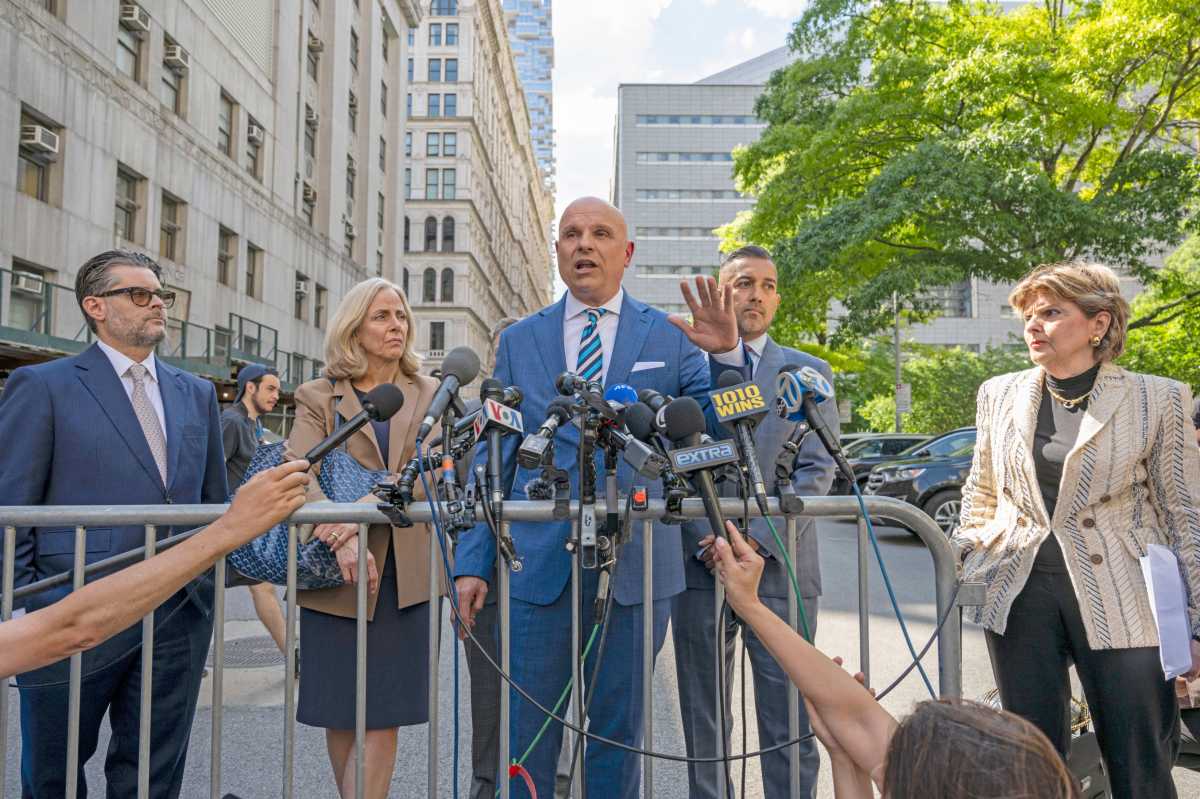
The name Arthur Aidala may not be on everyone’s radar, but the names on his roster of high-profile clients are widely recognized.
Over the course of two decades of practicing as a criminal defense attorney, Aidala has represented major, and at times notorious, figures in business, entertainment, and politics. He was often seen at trial by the side of former Hollywood producer and accused sexual predator Harvey Weinstein; he represented Ghislaine Maxwell, the ex-partner of alleged serial pedophile Jeffrey Epstein and Rudy Giuliani, the former New York City mayor turned acolyte of President Donald Trump. Aidala represents Giuliani in his Georgia election interference case and served as his counsel in his New York disbarment case.
Recently, Aidala took on the role of defender to Steve Bannon, a supporter of President Donald Trump, who during Trump’s first term allegedly raised millions of dollars to privately build the wall along the U.S. Mexico border. The Manhattan District Attorney’s Office has charged Bannon with money laundering, conspiracy and a scheme to defraud.
Bannon pleaded guilty to defrauding donors, but prosecutors dropped the money laundering and conspiracy charges against him as part of the deal, according to published reports. He was also spared from having to go to trial or serve any prison time.
Aidala, a managing partner at the law firm Aidala, Bertuna & Kamins, is also well-established in New York’s political arena. Ingrid Lewis-Martin, Mayor Eric Adams’ former chief adviser who was indicted on corruption charges by the Manhattan District Attorney’s Office late last year, is a friend and now one of Aidala’s clients.
A fixture in the media world
Representing such well-known individuals brings Aidala, 57, into regular contact with the press. With experience over many years, Aidala told amNewYork Law, he has established a level of comfort with the media.
That comfort has its roots in his experience with his namesake, his grandfather Artie Aidala, who had his own column, “You Said It,” in the since-shuttered New York Daily Mirror. Artie Aidala would go out on the city streets and ask New Yorkers for their opinions on an issue of the day, Aidala said.
He often accompanied his grandfather to Room 9, the press room in New York City Hall, said Aidala, who now is a regular attendee at the City Hall press corps’ annual charity dinner performance — the Inner Circle Show.
Aidala grew even more at ease around reporters and media personalities when he joined Fox News as a legal analyst in 2004, a role he held for 12 years.
“When you’re spending time with the likes of Shepard Smith and Megan Kelly and Bill O’Reilly, there’s a comfort level,” Aidala said. “You realize they’re human beings too and have a job to do.”
Aidala now hosts “The Arthur Aidala Power Hour,” a radio program which runs weeknights on AM970. The show combines Aidala’s analysis of the day’s legal news with an upbeat look at life in New York City.
“It’s a glass-half-full kind of show,” Aidala said. “I think it’s easy for people to find all the bad things in New York, to find all the bad stories, all the bad statistics. It’s a lot harder to find all the great things about this city, like why more young people are coming to New York than ever before.”
Good news and bad news
But press attention is a double-edged sword. When it comes to scrutiny of his clients, Aidala said that could be the “worst-case scenario,” as it can make prosecutors and judges less willing to make a deal or be lenient with his clients.
“The prosecution and sometimes the judges act much more conservatively and much more restrained when the media is watching” if they think restraint is “in their own best interest to get reelected as a judge or get reelected as a prosecutor,” Aidala said. “In other words, the prosecutor is not going to be willing to play ball as much. They’re not going to take things into consideration like the person’s history and background.”
Aidala insisted that his approach to dealing with reporters is to be as honest as possible.
“I’m always honest,” Aidala said. “If I know something that they want the answer to, but if I can’t tell them, I’ll just tell them, ‘Look I know, but I just can’t tell you that.’”
When determining what information he can disseminate to reporters during a trial, Aidala said he “sticks close to what the law says I can and cannot do.”
Aidala, who represents clients widely viewed as having committed heinous crimes, has the uphill task of drumming up public sympathy. He said he does so by being “realistic” about how he portrays his clients, not painting them as saints, while also being clear about belief in their innocence.
Using Harvey Weinstein as an example, Aidala said, “You say some obvious things that are true and accurate.”
“‘There are two sides to every story, and Mr. Weinstein has his side, and he is focused on his side being heard by a jury,’” Aidala said. “‘We’re confident that when 12 New Yorkers hear Mr. Weinstein’s side of the story, he’ll be fully exonerated.’ You’re not gonna say ‘And by the way, he’s gonna be nominated for a Nobel Peace Prize.’ Because you’ll lose all credibility.”
Aidala was successful in getting Weinstein’s 2020 rape conviction overturned by the New York State Court of Appeals earlier this year. The court ruled that Weinstein was not given a fair trial because the trial judge, Justice James Burke, allowed testimony that included accusations that were not part of the charges against him.
Maintaining credibility is the most important aspect of representing clients like Weinstein, Aidala said.
“You can’t lose credibility with your client, you can’t lose credibility with the media, you can’t lose credibility with the judge, and you definitely can’t lose credibility with the jury,” he said. “Once you lose credibility with the jury, you’re done.”
Compassion and boundaries
Another challenge Aidala says he navigates is managing the emotional distress of his clients over months-long trials without crossing ethical boundaries. One way to provide support and maintain ethical guardrails is to always meet clients in his office rather than at a restaurant or at home.
“But there are some times when a client just needs a hug,” Aidala said. “I’ll say, ‘Hey, you look like you need a hug. Do you want a hug?’ And if they say ‘no,’ we move on.”
Aidala said he was inspired from an early age by his father, Louis Aidala, a prominent defense attorney who counts among his clients Jennifer Lopez, when she was a witness to a 1999 nightclub shooting involving her then-boyfriend, the hip-hop mogul Sean “Diddy” Combs. The elder Aidala would march around the family living room practicing his opening statements. Aidala attended college at the State University of New York with hopes of pursuing a career in acting but then switched to law school at City University of New York and followed in his father’s footsteps.
Aidala began his career in 1993 as a prosecutor in the Brooklyn District Attorney’s office. Consoling the families of crime victims as a prosecutor taught him the empathy that now helps him deal with clients who are going through emotional minefields, he said.
From solo to boutique
In 1997, Aidala left the district attorney’s office to run for a southern Brooklyn City Council seat but lost the race by 108 votes in the Democratic primary, he said. The seat was ultimately won by former GOP City Council Member Marty Golden.
Afterward, Aidala started his own law firm in the Dyker Heights section of Brooklyn. That firm grew into the one Aidala runs today out of a Manhattan office, along with his wife, Marianne Bertuna, and retired Brooklyn judge Barry Kamins.
“I started all alone, and all these years later, if I could say so, with a degree of humility but also pride, we’re a powerhouse boutique litigation firm on the criminal side and the civil side,” Aidala said.
In addition to criminal defense, Aidala said his firm handles civil matters, wills, trusts, and estates. Known as a boutique, the firm has a staff of roughly 25, about 19 of whom are attorneys.
Aidala’s legal team includes retired Justice John Leventhal, who sat on the Appellate Division, Second Department bench and retired military Judge Michael Farkas.
Aidala’s success as a private attorney has hardly gone unnoticed.
He was reportedly on Trump’s list of candidates to be the next U.S. Attorney for the Eastern District of New York, a development first reported by the New York Daily News late last year. The federal prosecutor’s office covers Brooklyn, Queens, Long Island, and Staten Island.
For his part, Aidala said he knew “very little about” being considered for the post.
“It’s flattering,” Aidala said. “It’s other people who have campaigned without my knowledge on my behalf. Just saying, ‘Look, we think this person possesses the ethics and talents to be a great leader of these five major counties in the United States of America.’”