


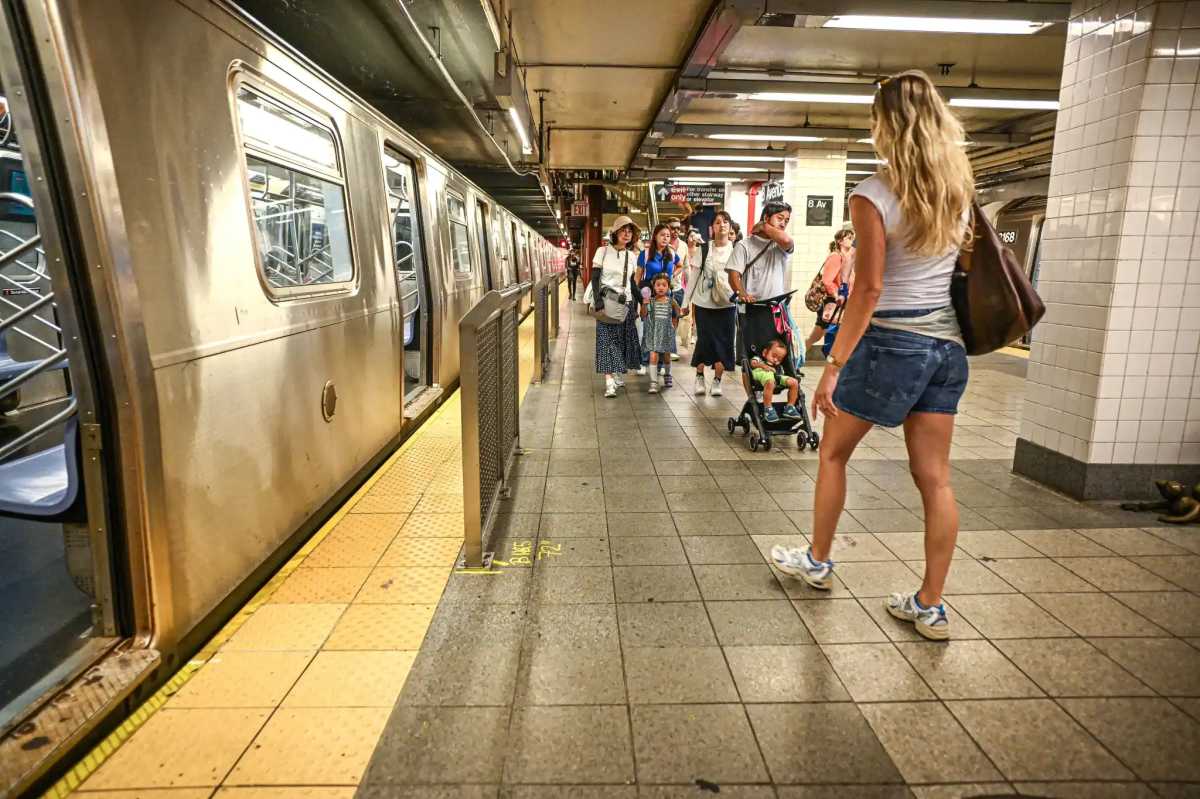
New York City’s transit world was rocked by a series of twists, turns, and switch-tracks as it barreled down the long tunnel of 2025.
From the much-anticipated start of congestion pricing at the beginning of the year to the F and M train swap and the phasing out of the MetroCard in December, there was no shortage of major transit news over the past 12 months.
amNewYork has been here for it all. Join us for a ride back through the year’s biggest transit stories.
Congestion pricing
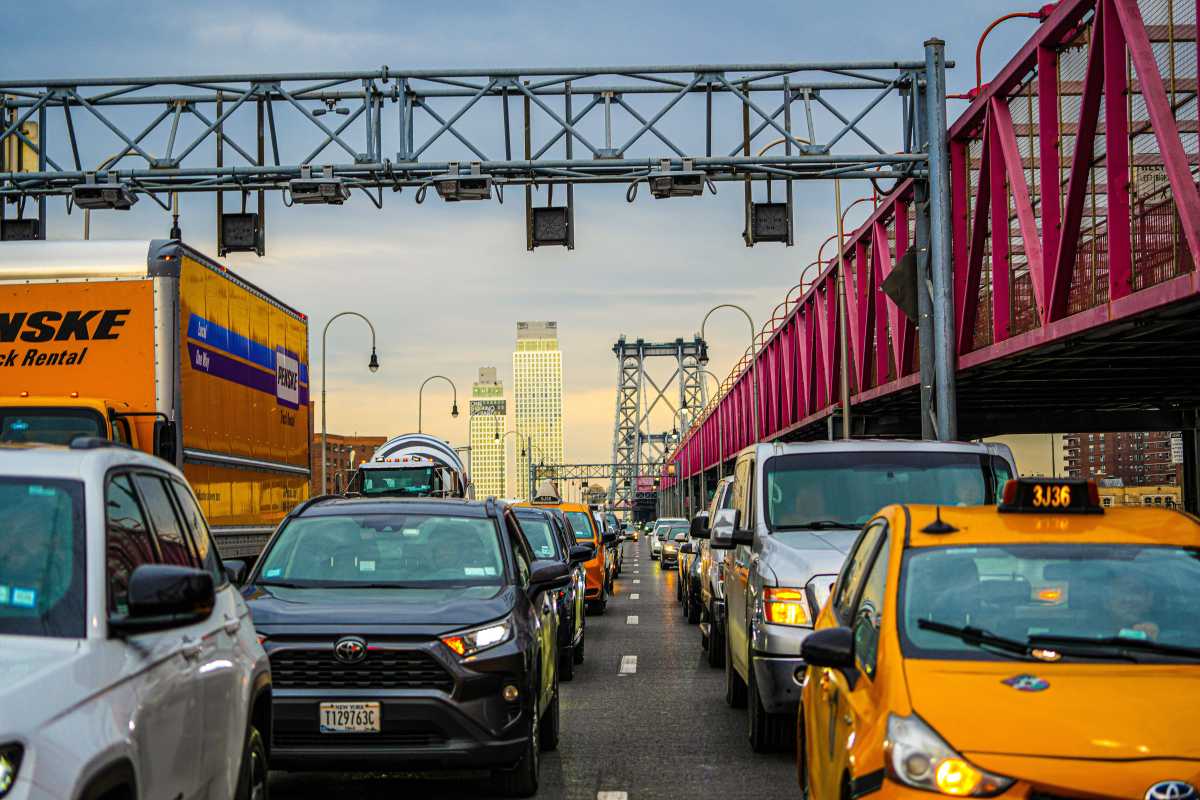
The year kicked off with the launch of congestion pricing, a state toll program designed to raise money for the Metropolitan Transportation Authority by charging drivers who enter Manhattan below 61st Street.
Under congestion pricing, drivers must pay a $9 base toll to go below 61st Street, an area known as the Congestion Relief Zone (CRZ). The toll varies based on vehicle size and what time of day it enters the CRZ.
The toll cameras went live on Jan. 5 and have continued to run since, despite the Trump administration’s repeated attempts throughout the year to shut them down. Gov. Kathy Hochul has fiercely defended the program from Trump, insisting repeatedly that the “cameras are staying on” in the face of immense pressure to turn them off.
Hochul became one of the program’s greatest champions after delaying its launch for several months last year amid the 2024 midterm elections.
It did not take long before MTA brass claimed the program as a success. They have reported that it has significantly reduced traffic in the CRZ, generated hundreds of millions of dollars in revenue, improved air quality in the five boroughs, and served as a boon to local businesses.
The revenue gained from congestion pricing is earmarked for a slew of major capital upgrades to the city’s aging mass transit system. The priorities it funds include purchasing new subway cars, updating decades-old signal systems, and making more stations accessible under the Americans with Disabilities Act.
The MTA board approved contracts for a few of those projects in its final meeting of the year on Dec. 17. The panel greenlit $1.75 billion in contracts to replace the aging signal system on the A/C line in Brooklyn and Queens for the first time in nearly a century and install new elevators at five stations.
Fare evasion
Throughout this year, the MTA has continued its fight to stymie rampant fare evasion on the city’s subways and buses.
The MTA has taken a variety of measures intended to stem fare evasion losses, found to reach hundreds of millions of dollars each year. Those include installing spikes and paddles on fare gates throughout the system, piloting new fare gates at several stations, hiring unarmed gate guards, and delaying the opening of emergency exit doors at many stations.
During the MTA’s Dec. 15 board committee meetings, agency brass announced they would soon outfit fare gates at most subway stations with spikes and paddles, intended to make it harder for fare beaters to vault over turnstiles.
New York City Transit President Demetrius Crichlow claimed at the meeting that the 327 stations that already have the features have seen fare evasion decreases of up to 60%.
At the same time, the agency is testing new fare gates at 20 subway stations, starting with one at Broadway-Lafayette Street in Manhattan and another at Third Avenue-138th Street in the Bronx.
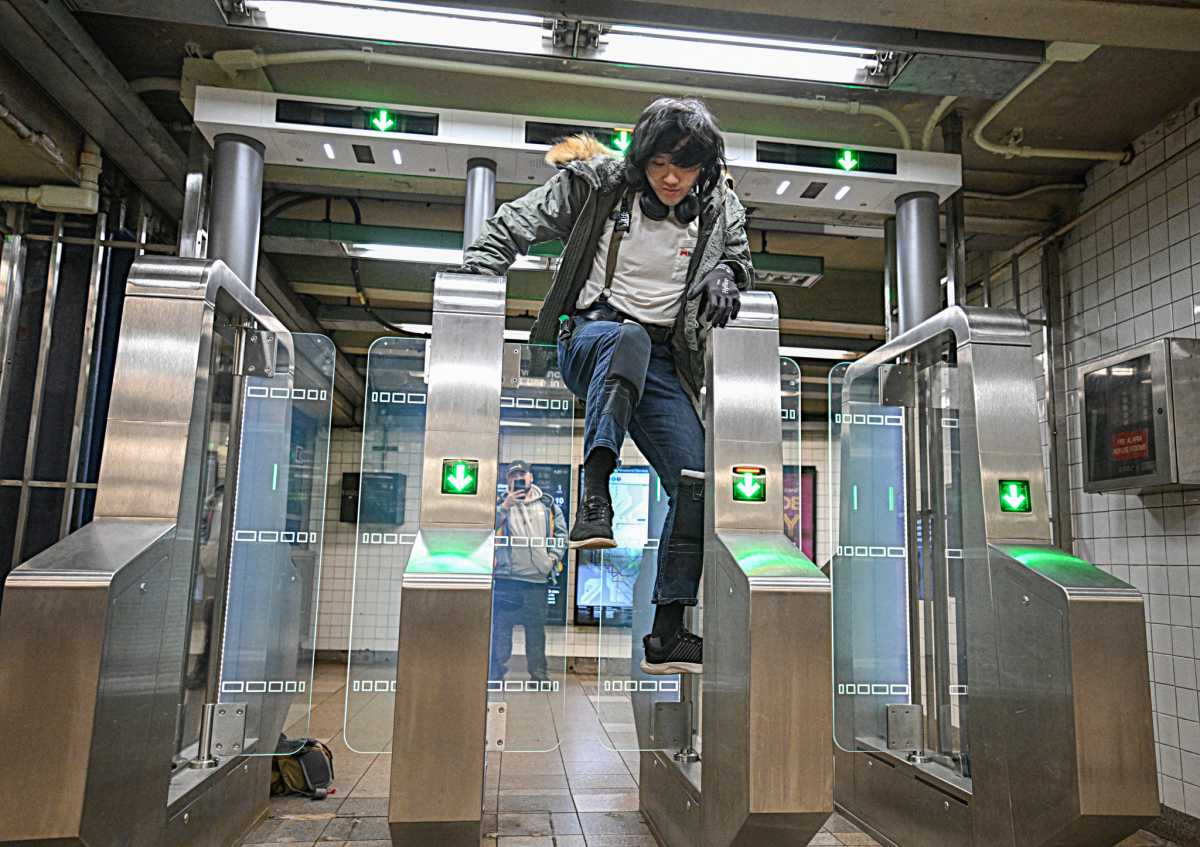
The gates feature tall and wide glass doors that swing open when riders pay their fare. They are also equipped with censors to detect anyone trying to get through without tapping and sound loud alams when a fare-beater gets by. Of course, some determined individuals found a way to breach even these devices.
MTA Chair and CEO Janno Lieber said the agency is also looking at adopting a “European style” of fare enforcement on city buses.
In practice, Lieber has said that it would involve civilian fare agents performing random checks to see if bus riders paid for their trips. The agents will be able to check if riders have paid with OMNY, the MTA’s tap and ride system, by using handheld devices.
The system will be introduced once OMNY has been fully implemented and the use of coins has been phased out on city buses.
Fare hikes, and the disappearing MetroCard
The MTA board approved 10-cent fare hikes for the city’s subways and buses in September.
Starting in January, riders will now pay $3, up from $2.90, to take the subway or the bus. Half-fare rides are increasing from $1.45 to $1.50.
Express bus fares will also increase from $7 to $7.25, with reduced fares on the routes rising from $3.50 to $3.60.
The MTA is also raising the price of its fare cap from $34 to $35, which is less than its originally planned $36 hike. Under the fare cap, those who pay for 12 trips in a week get to take all subsequent rides for free.
The MTA also plans on raising fares by another 4% in 2027 and 2029.
This year’s increase, which the MTA says is necessary to cover operating costs, has drawn backlash from riders and elected officials.
City Council Transportation Chair Selvena Brooks-Powers penned a letter to Gov. Hochul last week, asking the state’s top executive to boost subsidies to offset planned fare increases for 2027 and 2029.
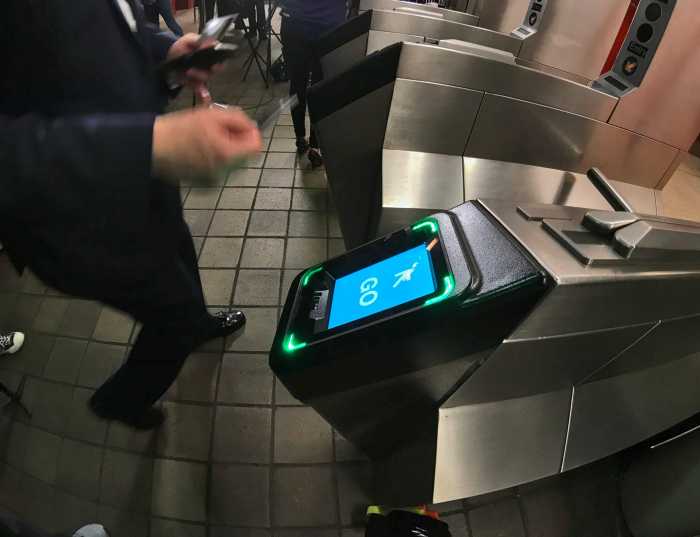
And as 2026 dawns, New Yorkers will be paying for their subway and bus rides with OMNY rather than MetroCards. On New Year’s Eve, the MTA will phase out all sales of the plastic MetroCards, which were first introduced in 1994 as a replacement for the traditional subway token.
F and M train swap
At the beginning of December, the MTA swapped the F and M trains’ routes between Manhattan and Queens.
F trains are now running through the 53rd St. tunnel between the two boroughs, while M trains are traveling via the 63rd Street corridor through Roosevelt Island.
The permanent switch is in effect between 6 a.m. and 9:30 p.m. on weekdays. During late nights and weekends, the F train runs on its previous route between Manhattan and Queens and the M train only goes from Middle Village-Metropolitan Avenue in Queens to either Brooklyn or Lower Manhattan.

The MTA says the swap was necessary to clear a merge issue at the Queens Plaza Station that was causing delays on the Queens Boulevard line, which is used by the F, M, E, and R trains.
While the agency has yet to release specific data on the switch, officials said during their Dec. 15 meeting that it has improved service on the Queens Boulevard line.
“From my own experience, being out there on the line, those stop-and-go situations at Queens Plaza and near 36th Street are a thing of the past,” Bill Amarosa Jr., NYC Transit’s executive vice president of subways, said during the meeting.
“It’s too early to give any specific numbers, but early signs are that the swap is working and service is improving for riders accross the E, F, M, and R lines,” he added.
Transit crime plummets
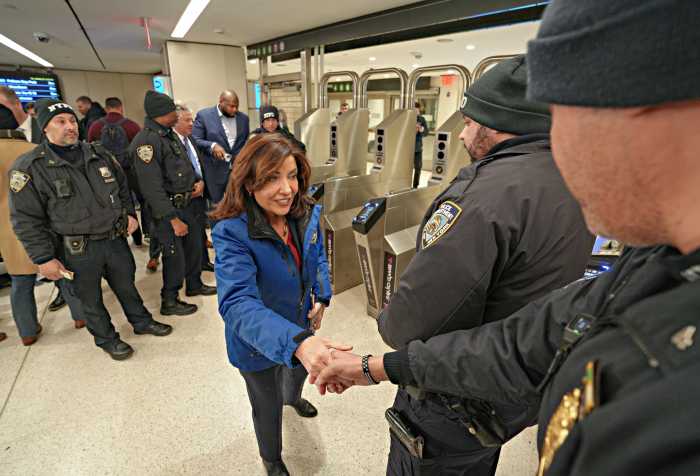
Crime on the subways has dropped to its lowest level in 16 years, Gov. Kathy Hochul announced on Dec. 18. Furthermore, subway crime has dropped 16% since the pre-pandemic year of 2019.
Additionally, 2025 is on pace to be the second-lowest non-pandemic year for subway crime in the system’s history.
The subways have seen a 5.2% decline in major crimes over the last 11 months, compared to the same period last year, according to the NYPD and the MTA. The system saw 113 fewer major crimes over the 11-month span — a drop from 2,050 in 2024 to 1,937 in 2025.

“New Yorkers are safer on our subways now than they have been in years,” NYPD Commissioner Jessica Tisch said during a Dec. 18 news conference.
Grand larcenies continue to “make up the bulk” of the crimes that straphangers fall victim to on the subways, according to the NYPD. Grand larcenies are high-value property thefts in which the assailant does not use force.
New ferry routes
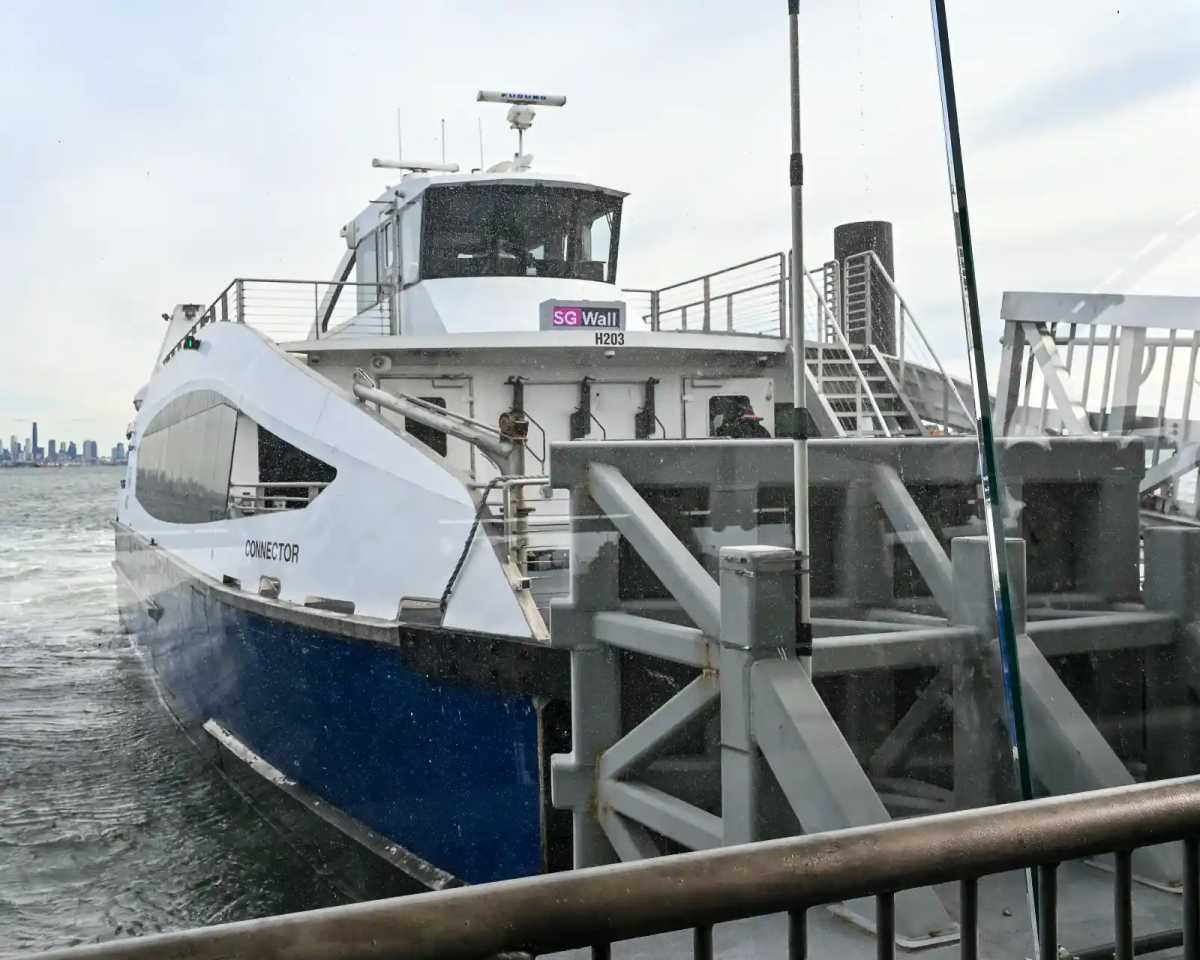
The relatively young NYC Ferry system began running service on revamped routes on Dec. 8.
NYC Ferry rolled out its reconfigured map as part of its NYC Ferry Optimization Plan, which it drafted using nearly 15,000 public responses earlier this year. The redesign is intended to deliver faster trips, better connections, and improved service.
The most notable new route connects Brooklyn to Staten Island, the first ferry to run between the two boroughs in decades. The ferry runs between southern Brooklyn, Staten Island, and the west side of Manhattan.
The first ferry to travel between the two boroughs in over half a century ran on Dec. 8. NYC Ferry introduced the route following years of advocacy from both Brooklyn and Staten Island elected officials.
“This has been a huge win for both our boroughs,” City Council Member Kamillah Hanks (D-Staten Island) told Brooklyn Paper at the time. “How we develop Staten Island’s North Shore is through transportation. So this is a huge step, and we are so excited to be back in touch with our sister or brother, however you want to call it, borough.”
Another change combined both the Rockaway and Soundview routes, now connecting the peninsula at the southern end of Queens to the east Bronx via the city’s waterways.