
There are entrances, and then there are arrivals that feel like the first page of a long-suppressed novel—disquieting, magnetic, and impossible to put down. Connor Wright’s New York debut belongs unequivocally to the latter. Undeniably, this body of work greets the viewer with the intimacy of a whispered secret and the force of an unexpected confession, a kind of aesthetic breathlessness that lingers in the mind long after the first encounter. In an instant, one realizes they are facing far more than a collection of paintings—what stands before them is an excavation.
Wright cuts through the collective sediment of images—public, private, ephemeral, sacred—and exposes the psychological bedrock that binds them. The gesture summons the memory of those rare artists who understood the image as a moral text: Goya dissecting the nightmares of empire, Daumier unraveling social duplicity, Dix revealing the brittleness of civility. Wright emerges as their contemporary descendant, wielding the fractured visual grammar of our time to chart the human condition with an unsettling, unforgettable precision.
The scale of his ambition becomes unmistakable in Alexa, Truth or Dare?, curated by Jesse Bandler Firestone and on view December 11– January 2026. Wright’s archive is vast: childhood snapshots, sports ephemera, thrift-store slides, bureaucratic documents, internet relics, and images whose origins are lost to the churn of digital culture. This inclusiveness is not chaotic; it is deeply philosophical and undeniably impactful. One turn in his studio leaves the mind pulsing, vibrant, thrilled that– at last– there is a voice to capture modernity. He flattens hierarchy with a kind of radical tenderness, acknowledging that in the modern psyche, there is no meaningful difference between an idolized photograph and an overlooked scrap. The technique recalls Richter’s memory-blurs and the Pictures Generation’s conceptual interrogations, though Wright diverges from both by infusing his compositions with emotional intensity—refusing the cool detachment of theory for something far more embodied.
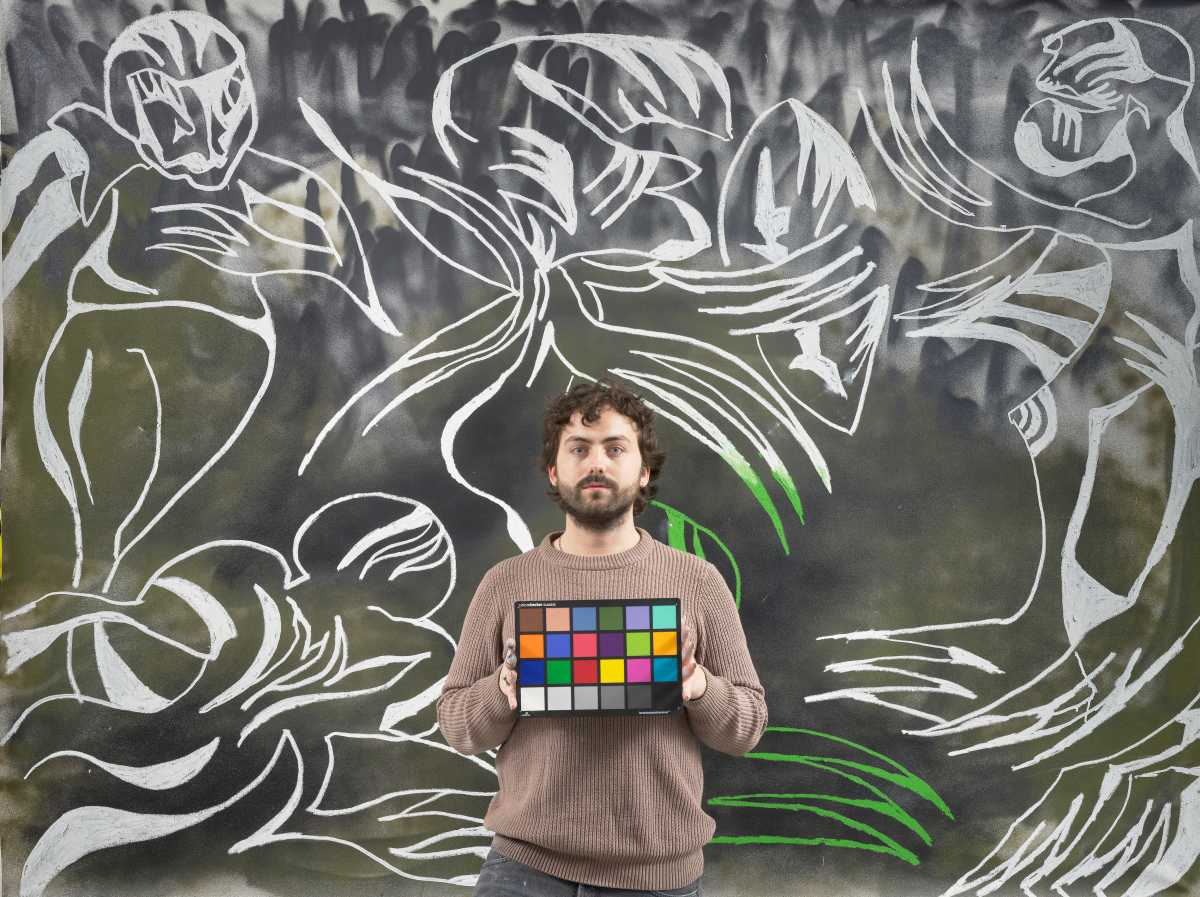
A kind of chromatic weather settles over the canvases before anything else. Wright’s sprayed grounds swell and recede like atmospheric fronts—lush gradients that conjure Mehretu’s layered worlds and the improvisational brilliance of early street art. Figures emerge slowly, elongated and queered to the brink of legend. Their lines—their real architecture—carry echoes of Pettibon’s incisive stroke, Ojih Odutola’s psychological mapping, and Golub’s brutal clarity. Yet Wright’s syntax carries its own nerve. The bodies hover between apparition and assertion, revealing themselves with the charged vulnerability of something both mythic and freshly born.
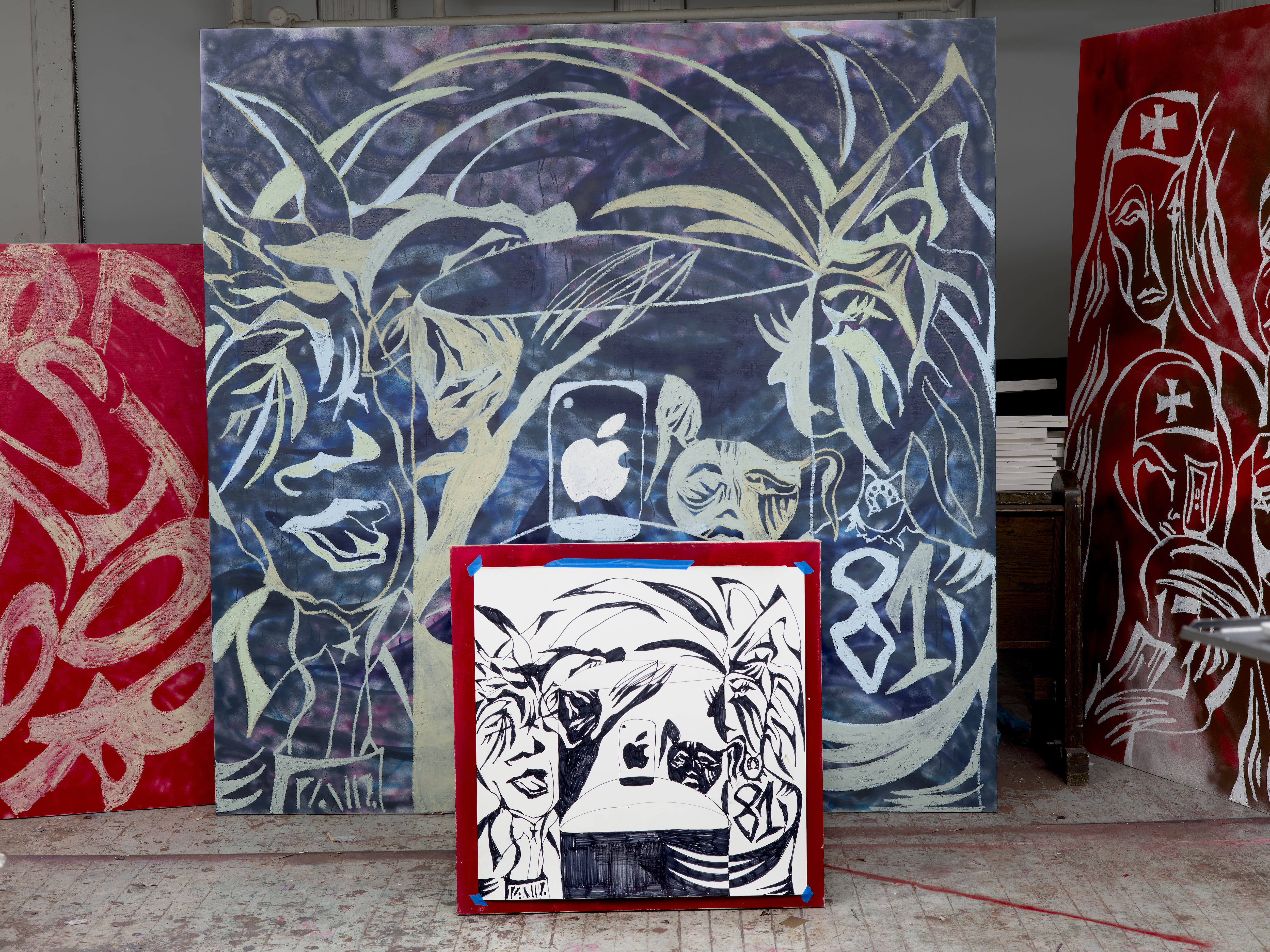
Wright’s hands remain one of the most arresting motifs in the show. They stretch, curl, proclaim. Acrylic nails gleam like ceremonial extensions of identity, recoding gesture into something akin to ritual. Art history grants hands an exalted place—from Caravaggio’s devotional theatrics to Mendieta’s earth-bound impressions—and Wright builds upon this lineage with a distinctly queer futurity. His figures announce themselves through the hand before the face, placing agency at the threshold of touch, creation, and revolt.
The deeper meanings surface in juxtapositions that feel both haunting and strangely playful. An iPhone rendered as if dug from an archaeological pit calls to mind Paik’s techno-prophecies and Steyerl’s interrogations of digital truth. A breastfeeding figure resurrects NASA’s “Nursing Mother” image sent aboard the Voyager spacecraft—a delicate symbol of human desire rendered with Wright’s wry, tender intelligence. Two towering women looming over a caricatured president embrace the grotesque tradition of Dix while channeling the camp brilliance of Catherine Opie. The combinations ignite a complex emotional palette—melancholy, satire, insistence, intimacy—without reducing any one note.
The true sophistication of Wright’s practice emerges in how seamlessly he translates chaos into legibility. He does not offer closure, nor does he sanitize the unruly nature of visual culture. Instead, he allows its contradictions to remain intact while unveiling their deeper logic. His canvases operate like maps—psychological, political, historical—charting a society overwhelmed by images yet desperate for something that still feels true.
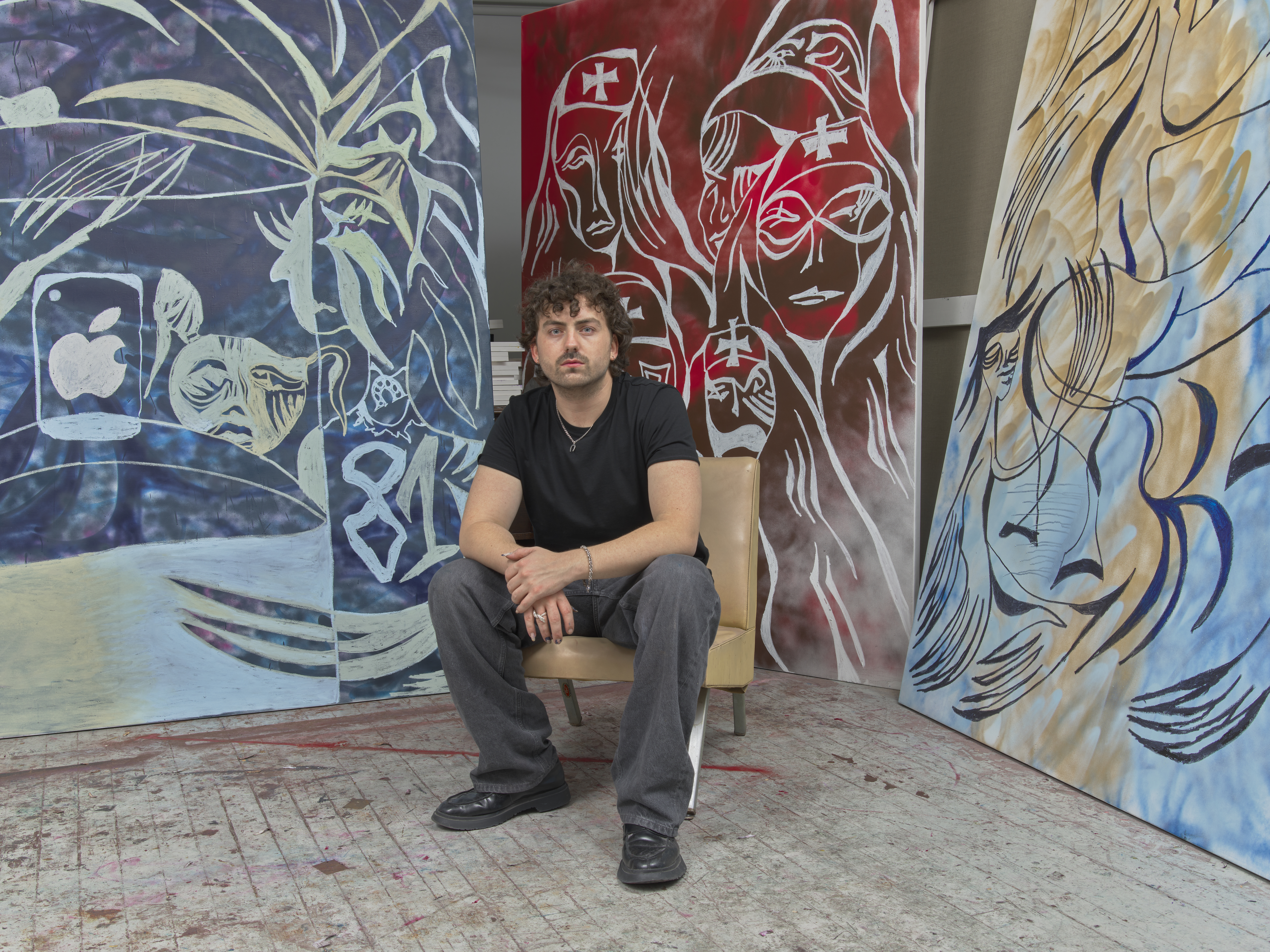
The lineage he joins is formidable. Wright stands in conversation with artists who confronted their eras with ferocity and imagination: Goya’s moral nightmares, Marshall’s examination of visibility, Mehretu’s geopolitical palimpsests, Ligon’s textual interrogations. It is in these hands that the artist finally answers the age old question– yes, indeed size does matter. His monumental scale signals the seriousness of his inquiry and makes clear that these paintings are not interior décor. They are installations of consciousness—bold declarations of what it means to be alive in a world that demands constant self-invention.
Wright’s debut does not feel tentative; it feels catalytic. His work reads as both document and prophecy, scrutinizing the visual mechanics of contemporary life while setting the terms for a new aesthetic vocabulary. The arrival of an artist with this much clarity rarely goes unnoticed.
Collectors, curators, and institutions who understand the long arc of art history will recognize the significance immediately. Wright is not simply entering the New York art world; he is shifting its center of gravity. His work is lucid, radical, and deeply human—proof that a new chapter of contemporary painting has already begun.